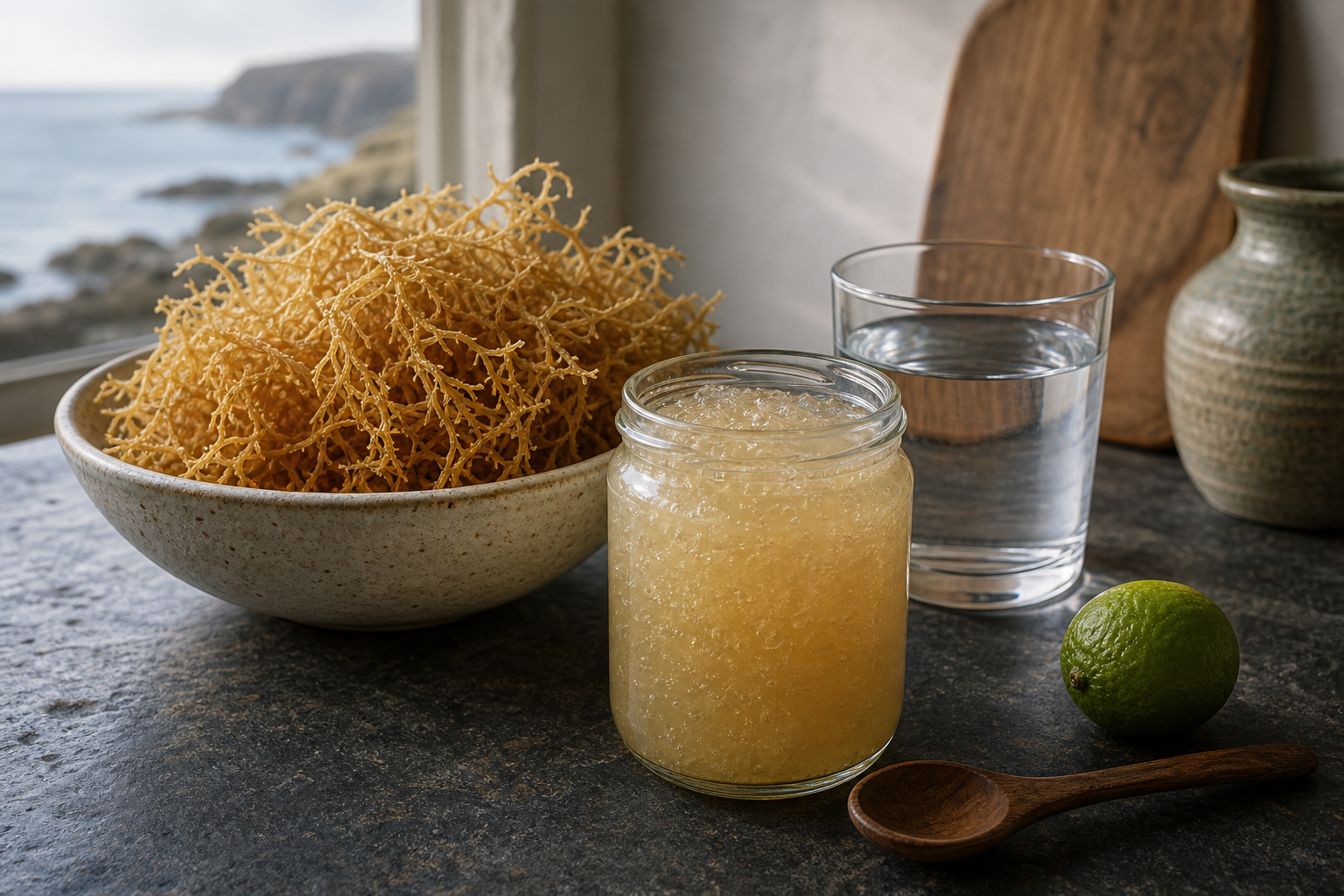
Sea moss is one of those ingredients that sounds simple until you try to buy it.
One seller calls it Irish moss. Another calls it gold sea moss. Someone else says purple sea moss, Chondrus crispus, Gracilaria, or Eucheuma cottonii. In Dr. Sebi circles, those names often get used in the same conversation even though they do not always point to the same seaweed.
That is where a lot of the confusion starts.
This guide is meant to clear that up without smoothing over the uncertainty. Sea moss is useful, but the name is messy. The species matters if you care about sourcing, nutrition data, and whether you are buying what you think you are buying.
Why the name causes confusion
Irish moss usually refers to Chondrus crispus, a red algae traditionally found along the cooler Atlantic coasts of Ireland, Britain, Europe, Canada, and parts of North America. It is also called carrageen moss. [1]
Sea moss, as the term is used in shops and online, is broader. It can refer to Chondrus crispus, but it is also commonly used for tropical red algae sold as gold sea moss or Caribbean sea moss. A lot of that warmer-water sea moss is associated with Gracilaria species. [2]
That does not mean one is automatically real and the other is automatically fake.
It means the common names are not precise enough by themselves.
If a seller only says "sea moss," you still do not know the species. You know the common name. To know more, you need the Latin name, the source region, and ideally some transparency around harvesting and testing.
The practical distinction
The cleanest way to think about it is this:
- Irish moss usually means Chondrus crispus, the cold-water Atlantic species.
- Tropical sea moss often means Gracilaria species, especially in Caribbean-style use.
- Other red algae such as Kappaphycus alvarezii or Eucheuma cottonii may also be sold under sea moss-style naming in some markets.
For a normal kitchen, that distinction is enough.
You do not need to become a seaweed taxonomist before making gel. But it is worth knowing that these are not all the same plant. They are all red algae, but different red algae can have different mineral profiles, textures, growing conditions, and traditional uses.
That is why the label matters.
Which sea moss did Dr. Sebi mean?
This is the part that needs the most care.
The current official Dr. Sebi Cell Food sea moss gel page describes its sea moss as wildcrafted Chondrus crispus, harvested from Atlantic waters including Ireland, Canada, and the United States. [3]
That is an important reference point. It tells us how Dr. Sebi's office is currently presenting its sea moss product.
At the same time, there is a real reason many followers connect Dr. Sebi's sea moss comments with tropical sea moss. In older discussions, he described sea moss in ways that people associate with a golden sea vegetable from warmer waters. That description sounds closer to the Caribbean-style sea moss commonly sold as Gracilaria than to the colder-water Irish moss most people mean by Chondrus crispus.
I would not state that as a settled fact.
It is possible Dr. Sebi was using the name Chondrus crispus because that was the name available to him. It is possible he was speaking loosely about sea moss as a category. It is also possible different suppliers, products, or periods involved different red algae.
The honest position is this: the current official product language points to Chondrus crispus, while some of Dr. Sebi's descriptions and the wider Caribbean sea moss tradition point toward tropical sea moss, often Gracilaria. Unless a specific product gives the species name, source, and testing, there is only so much certainty available.
The practical lesson is still useful. Dr. Sebi valued sea moss as a mineral-rich sea vegetable that could be prepared into a gel and used regularly in food. That is the part that matters most in daily practice.
Why sea moss matters in the Sebian lifestyle
Sea moss fits naturally into the Sebian lifestyle because it brings the sea-mineral side of the methodology into daily food.
Dr. Sebi often emphasized minerals, herbs, spring water, approved plant foods, and sea vegetables. Sea moss sits right in that area. It is not usually eaten like lettuce or cooked like kale. Once soaked and blended, it becomes a gel that can be stirred into other foods without much flavor.
That makes it practical.
Sea moss gel can be used in smoothies, teas, porridges, soups, sauces, fruit jellies, and homemade drinks. It is also useful because it thickens food without relying on cornstarch, gelatin, dairy, or gums.
That is the strongest everyday argument for sea moss. It is not a magic ingredient. It is a mineral-rich sea vegetable that is easy to prepare and easy to work into meals.
What sea moss contains
Sea moss is usually discussed for minerals, iodine, fiber-like polysaccharides, and its natural gelling quality.
Red algae can contain minerals, proteins, pigments, polysaccharides, and other compounds. The exact profile depends on the species, harvest location, season, processing, and drying method. [4]
That variation matters.
One bag of sea moss is not automatically the same as another bag. A dried Chondrus crispus product from the North Atlantic and a tropical Gracilaria product from the Caribbean may both be sold as sea moss, but they should not be treated as identical just because the common name overlaps.
Minerals and trace minerals
Sea moss is commonly valued as a mineral-rich food. The current Dr. Sebi Cell Food product page lists minerals such as calcium, potassium, magnesium, iron, zinc, iodine, and selenium in its sea moss gel description. [3]
You will also see the "92 minerals" claim everywhere in sea moss marketing.
I would be careful with that line. It may be part of the tradition and marketing language around sea moss, but it should not be treated as a precise guarantee for every product. Mineral content depends on the actual seaweed, where it grew, how it was handled, and whether the seller has testing to support the claim.
The safer way to say it is that sea moss is valued as a mineral-bearing sea vegetable.
Iodine
Iodine deserves its own mention because seaweeds can contain a lot of it.
Iodine is needed for thyroid hormone production, and seaweed is one of the best-known dietary iodine sources. [5]
The difficulty is that iodine levels in seaweed products can vary widely. Some products may contain modest amounts. Others may be much higher depending on the species and serving size. [6]
This does not make sea moss off-limits. It means it should be used with awareness.
If you have thyroid issues, take thyroid medication, are pregnant, are breastfeeding, or use seaweed products heavily, iodine is worth discussing with a qualified health professional. That is especially true if your sea moss is combined with bladderwrack, because bladderwrack is another iodine-containing seaweed.
Gel-forming compounds
One reason sea moss became so useful in kitchens is its texture.
Chondrus crispus is associated with carrageenan-type compounds, which help it form a gel. Gracilaria is important commercially because it is used for agar production. [1] [2]
That helps explain why different red algae can all end up in similar culinary roles. They are not the same species, but they can share that useful thickening quality.
How to choose sea moss
Buying sea moss is where the practical questions matter more than the slogans.
Start with the label. If the seller names the species, you know more than if the product only says "gold sea moss" or "wildcrafted sea moss."
Look for names such as:
- Chondrus crispus
- Gracilaria species
- Kappaphycus alvarezii
- Eucheuma cottonii
Then look at the source region. Cold-water Atlantic sourcing fits Chondrus crispus. Caribbean or other warm-water sourcing usually points toward tropical sea moss, often Gracilaria or a related red algae.
The product should smell clean and ocean-like, not chemical, rotten, or heavily perfumed. Dried sea moss may have salt, sand, or ocean debris on it, which is why rinsing matters. But it should not smell like bleach.
Good signs include clear species information, country or region of harvest, simple ingredients, preparation instructions, and quality testing where available.
Red flags include vague sourcing, no species name, dramatic medical-style promises, heavy perfume or chemical smell, and sellers leaning entirely on words like "gold," "purple," "raw," or "wildcrafted" without explaining what the product actually is.
Wildcrafted vs farmed sea moss
Wildcrafted means harvested from its natural ocean environment. Farmed sea moss is cultivated under more controlled conditions.
That distinction is useful, but it is not enough by itself.
Wildcrafted sea moss can still be poorly handled. Farmed sea moss can still vary in quality. The better question is not only whether it is wildcrafted or farmed, but whether the seller is transparent about the species, source, drying process, and testing.
I made a video on this topic because this is one of the easiest places for marketing to get ahead of the facts:
Use the label as a starting point, not the whole answer.
How to prepare sea moss gel
Sea moss gel is the easiest form to use in food.
The basic method is simple:
- Rinse the dried sea moss well.
- Soak it in spring water or filtered water until it softens and expands.
- Rinse it again to remove salt, sand, or ocean debris.
- Blend with fresh water until smooth.
- Pour into a clean glass jar.
- Refrigerate until it thickens into a gel.
The amount of water controls the texture. Use less water for a thicker gel and more water for a looser gel.
The simmer method can make the gel smoother and easier to break down, but prolonged aggressive boiling is not necessary for most kitchen use.
If you do heat sea moss, use the liquid. Water-soluble nutrients and some minerals can move into cooking water during boiling, which is one reason soups and teas make more sense than boiling and throwing the water away. [7]
How to store sea moss gel
Keep sea moss gel refrigerated in a clean, sealed glass jar.
Most homemade gels are best used within about one to two weeks. Some may last longer depending on cleanliness, water content, and storage, but freshness matters.
Throw it away if it smells sour or rotten, grows mold, changes color in a strange way, or tastes unpleasant.
You can freeze sea moss gel in small portions if you want it to last longer. Ice cube trays work well because you can thaw only what you need.
How to use sea moss gel
Sea moss gel is mild when it has been rinsed and prepared well.
That is why it works in so many foods. It can disappear into a recipe without making the whole dish taste like seaweed.
Common uses include:
- Blending into smoothies
- Stirring into warm tea after the tea cools slightly
- Adding to porridge
- Thickening soups and sauces
- Mixing into homemade drinks
- Using in fruit jellies or puddings
- Adding near the end of cooking when you want a thicker texture
The amount depends on the recipe. For drinks and smoothies, start with a small spoonful and adjust from there. For jellies or thicker sauces, you may need more.
Powders, capsules, and bottled gels
Whole dried sea moss gives you the most control because you can see, rinse, soak, smell, and prepare it yourself.
Powders, capsules, gummies, and bottled gels are more convenient, but they make quality harder to judge.
If you use those forms, read the label carefully. Look for the species name, source region, added ingredients, sweeteners, preservatives, and whether it is combined with bladderwrack or other herbs.
Capsules are especially easy to overuse because they feel separate from food. Sea moss is still a seaweed product, and iodine still matters.
Cooking with sea moss
Sea moss is useful in cooked dishes because it thickens.
Soups, sauces, teas, and stews are the easiest cooked uses. Add the gel near the end when possible, especially if you are using it more for texture than long simmering.
For cold preparations, use it in smoothies, fruit jellies, puddings, cold soups, or sauces. This keeps the process simple and avoids unnecessary heat.
The main thing is not to make sea moss more complicated than it needs to be. Prepare the gel cleanly, store it properly, and use it where the texture actually helps.
Sea moss recipes and practical uses
If you are new to sea moss, start with recipes where the gel has a clear job.
Sea Moss Gel is the base. Once that is made, it can go into drinks, teas, sauces, and desserts.
Fruit jellies are another simple use because sea moss naturally helps with texture. The Mango Jelly recipe shows that better than a long explanation.
For savory meals, use small amounts in soups and sauces. The goal is a little body, not a heavy gel texture.
Frequently asked questions
Is Irish moss the same as sea moss?
Not always.
Irish moss usually means Chondrus crispus. Sea moss can mean Chondrus crispus, but it is also used broadly for tropical red algae such as Gracilaria. The only way to know is to check the species name and source.
Is gold sea moss better than purple sea moss?
Color alone is not enough to judge quality.
Gold, purple, red, and greenish sea moss can all appear in the market. Color can be affected by species, drying, sun exposure, processing, and marketing. Species, source, smell, texture, cleanliness, and testing matter more than color.
Is pool-grown sea moss bad?
Pool-grown or tank-grown sea moss is usually presented as lower quality by sellers who promote wildcrafted sea moss.
The concern is that controlled cultivation may not reflect the same natural ocean environment, mineral exposure, and growth conditions. That said, "wildcrafted" is also not a guarantee by itself. Ask what species it is, where it came from, and how it was handled.
Should I buy whole, cut-and-sifted, powder, capsules, or gel?
Whole dried sea moss gives the most control. Cut-and-sifted sea moss is just dried sea moss cut into smaller pieces, and it can be prepared the same basic way.
Powder and capsules are convenient but harder to inspect. Bottled gel saves time but depends entirely on the seller's freshness, handling, and ingredients.
Can I use Gracilaria instead of Chondrus crispus?
For normal kitchen use, many people use tropical sea moss gel in the same kinds of recipes: smoothies, teas, jellies, sauces, and drinks.
If you want to follow the current official Dr. Sebi Cell Food product language strictly, look for Chondrus crispus. If you are using Caribbean-style gold sea moss, it may be Gracilaria or another tropical red algae. The important thing is to know what you are buying instead of relying only on the common name.
Does sea moss contain 92 minerals?
That claim is common in sea moss marketing and in Dr. Sebi circles.
It is better treated as tradition or marketing language unless a specific product provides testing. Sea moss can be mineral-rich, but the exact mineral content varies by species, location, season, and processing.
How long does sea moss gel last?
Homemade sea moss gel is usually best used within one to two weeks in the refrigerator.
Use a clean jar, keep it cold, and avoid dipping dirty spoons into it. If it smells off, grows mold, or changes in a way that seems wrong, throw it away.
Can you freeze sea moss gel?
Yes. Freeze it in small portions and thaw what you need.
This is useful if you make more gel than you can use in a week or two.
Practical takeaway
Sea moss is useful, but the name is not precise.
If you want the strict official-product route, look for Chondrus crispus. If you are buying golden Caribbean-style sea moss, it may be Gracilaria or another tropical red algae. Neither label is enough by itself unless the seller is clear about species and source.
Use sea moss as a mineral-rich sea vegetable and practical gel. Check the label. Prepare it cleanly. Be mindful of iodine. Then use it in foods where it actually makes sense.
Sources and further reading
- [1] Britannica: Irish moss
- [2] ScienceDirect Topics: Gracilaria
- [3] Dr. Sebi's Cell Food: Sea Moss Gel product page
- [4] Life: Seaweed Nutritional Value and Bioactive Properties
- [5] NIH Office of Dietary Supplements: Iodine Fact Sheet
- [6] Foods: Commercially available kelp and seaweed products, iodine source or risk
- [7] Journal of Nutritional Science and Vitaminology: Cooking losses of minerals in foods